Nelson Mandela

Mandela Reveals the World’s Most Powerful Weapon

By Dr. David Nunan

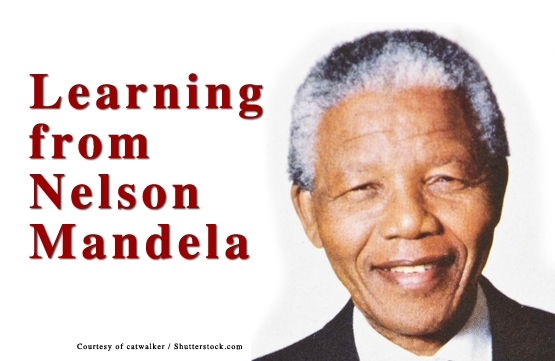
SOME of the best teachers are not professional educators. On the surface, this statement might seem a paradox. Educators are defined by their work as teachers. I’m not trying to suggest that the many people who make their livings as educators aren’t great teachers. It is that some of the most instructive lessons I have learned about living and learning haven’t come from people with formal teaching qualifications nor from people who have worked as teachers, but from people who have nevertheless changed the world. One such person is Nelson Mandela: a great teacher, a great leader and one of the most powerful people of the modern era. Mandela valued education above all else. He once said, “Education is the most powerful weapon which you can use to change the world.” In an interview, when asked what is the single greatest problem facing the world right now, he replied at once, “Poverty and lack of education – these two problems combined. It is important for us to ensure that education reaches everyone.” (Interview in the Reader’s Digest, July 29, 2013.)
(more…)

Dispelling Myths

Dispelling Myths

By Dr. David Nunan

ONE of the things that I enjoy doing is dispelling myths. My chosen field, TESOL, abounds with myths such as “You can only boast that you speak a language if you sound like a native speaker” or “You can never learn to speak a language to a high level of proficiency if you don’t start learning at an early age.”

The myth that I want to dispel here is common in Japan, and one that I come across time and time again. This is the notion that Japanese are somehow genetically predisposed not to be able to speak languages other than their own with any degree of proficiency. A related belief is that foreigners can’t learn Japanese.

(more…)

GLOBAL EDUCATOR DAVID NUNAN

Educating Sanjay

ALL of the tables in the coffee shop were taken. I looked around and saw an Indian man in his early thirties at a large table near the entrance. I raised an eyebrow, and he smiled and nodded, so I slid my tray onto the table and took the seat opposite him. A large handbag was hooked over the edge of the table. He noticed me looking at it and laughed.

“No,” he said, “it’s not a man-bag. It belongs to my wife.”

“Oh, I hope I’m not…”

“No,” he said. “She’s gone to pick up my son from the school bus.”

He introduced himself as Kapil, as in Kapil Dev, the great Indian cricketer. “But call me Kap. Everybody does,” he said. He told me he was a banker, adding that he is ”between jobs.” That’s like a lot of bankers in Hong Kong during the global financial crisis that never seemed to end. He had a British accent of indeterminate provenance, and I asked him where he was from. “Harrow,’ he said. “Just outside London. I was born and raised there but have spent most of my working life in Asia – Singapore, Tokyo and now Hong Kong.”

I finished my coffee and was about to depart when Kap’s wife appeared with their four-year-old son. The boy rushed to his dad for a cuddle, and then produced a painting from his backpack. He pushed it across the table for Kap’s approval.

(more…)

GLOBAL EDUCATOR DAVID NUNAN

World-acclaimed linguist and language educator Dr. David Nunan shares his own personal learning experiences from his 30 years in the classroom.

Only connect

ONE of the joys of being an English language teacher for non-native English speakers is the opportunity to meet a diversity of individuals from different cultures and walks of life. Over the years, I have taught (and learned from) thousands of students of all ages and backgrounds. Occasionally I bump into former students and listen eagerly to the stories they tell me about their lives, from their successes and failures to their triumphs and tragedies. Once or twice at the end of a conversation, a former student has said, “Thank you for teaching me. You changed my life.” Hyperbole, perhaps, but for a teacher nothing is more rewarding than that from a former student.

(more…)