The following article by Donald Richie is a reprint of his article that first appeared in the Tokyo Journal in April 1991.
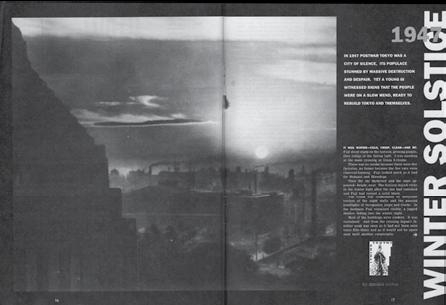
IN 1947 Postwar Tokyo was a city of silence, its populace stunned by massive destruction and despair. Yet a young GI witnessed signs that the people were on a slow mend, ready to rebuild Tokyo and themselves. It was winter – cold, crisp, clear – and Mt. Fuji stood sharp on the horizon, growing purple, then indigo in the fading light. I was standing at the main crossing at Ginza 4-chome.
There was no smoke because there were few factories, no fumes because the few cars were charcoal-burning. Fuji looked much as it had for Hokusai and Hiroshige.
Then the sky darkened and the stars appeared – bright, near. The horizon stayed white in the winter light after the sun had vanished and Fuji had turned a solid black.
The Ginza was illuminated by acetylene torches of the night stalls and the passing headlights of Occupation jeeps and trucks. In the darkness Fuji remained visible, a jagged shadow fading into the winter night.
Most of the buildings were cinders. It was wasteland. And from the crossing Japan’s familiar peak was seen as it had not been seen since Edo times and as it would not be again seen until another catastrophe.
At the crossing there were only two large buildings still standing. One was the Ginza branch of the Mitsukoshi Department Store. But it was gutted, hit by a fire bomb, and even the window frames had been twisted by the heat. Across the street was the white stone Hattori Building with its clock tower. It was much as it had always been, once the clock itself was repaired. With its curved front window, cornices, and pediments, it remained from the pre-war Ginza.
The complete article is available in Issue #271. Click here to order from Amazon
(more…)