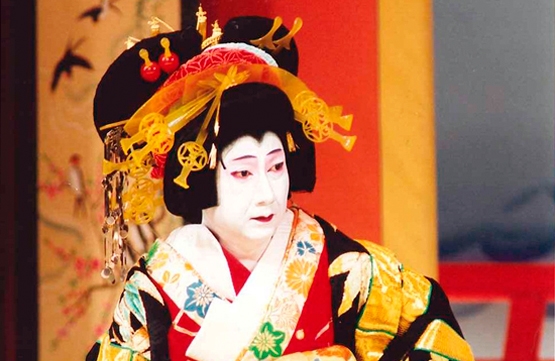
Senjaku Nakamura
Keeping the Kabuki Tradition
From his great-great-grandfather Kanjaku Nakamura III to his son Toranosuke Nakamura, Senjaku Nakamura and his family have been keeping the tradition of kabuki alive. Senjaku debuted at the famous Kabuki-za theater in 1967 and is a talented and trained onnagata, a male actor who plays female roles in kabuki.
Interview by Hana Kobayashi and Chisato Kato
TJ: How did you get started in your career as a kabuki actor?
NAKAMURA: I made my debut as a kabuki actor at Kabuki-za in Tokyo when I was six years old. Based on the tradition that an actor will succeed if he starts training on June 6 at the age of 6, I started training that day. I made my debut in November of that year. The performance was dedicated to the first Ganjiro Nakamura, my grandfather, on the 33rd anniversary of his death.
TJ: As the member of a kabuki family, what do you want to hand down to your descendants of what you have inherited from your ancestors?
NAKAMURA: Our family is Kamigata (Osaka)-oriented and is self-taught. We learned to act by watching and imitating veterans. It is significantly different to Edo (Tokyo) kabuki. I suggest that future kabuki actors learn how to act by watching veterans, as this is essential for developing a high level of professionalism.
TJ: You play different roles on the same day. Is there anything you do to prepare for that?
NAKAMURA: Nothing special. However, since it is impossible to change my body shape in a single day when I play both male and female characters, I put a cotton pad called a Kiniku under the costume, or I make myself look fatter or skinnier during the wig fitting. I can also vary my appearance with makeup. Also, I have to be careful with my voice. I focus on abdominal voice production in order not to crack my voice. For a female role, I use the highest tone of my own voice because it is difficult to convey emotions in falsetto. Training in Nagauta or Gidayu would help in gaining the ability to create high-pitched sounds.
TJ: You have given performances in foreign countries such as the U.S. and Germany. Did you feel anything different from what you feel in Japan?
NAKAMURA: I performed in the U.S., Germany, the U.K., Italy, Romania and Japan. Of course the responses were different depending on the audience’s nationalities; but more importantly, the responses are different depending on the program. Receiving a standing ovation or curtain call, even in Japan, is not attributed to the audience’s nationality but to the quality of program. In other words, a play is universal. A good play is acclaimed regardless of where it is performed. I was told that I couldn’t expect a standing ovation like in Japan on the first day of performances in Germany, but Natsumatsuri Naniwa Kagami by Heisei Nakamura-za received a full standing ovation.
TJ: 歌舞伎役者としてキャリアをスタートさせ た経緯をお聞かせ願えますか?
ナカムラ:初舞台は 6 歳(1967 年)、東京歌 舞伎座の舞台でした。日本の伝統で 6 歳 6 月 6 日に稽古事を始めると上達するという言い伝え があり、私も 6 歳 6 月 6 日から日本舞踊を始め、 11 月に歌舞伎役者としてのスタートを切りま した。その公演は祖父初代中村鴈治郎の 33 回 忌興行で、その機会に合わせての初舞台となり ました。
TJ: 代々歌舞伎業を営まれてきたご一族である と存じます。扇雀様がご先祖から伝えられ、 守られてきたものの中で、これから扇雀様ご自 身がご子孫に残し伝えていきたいと最もお考え になるもの / ことは何ですか?
ナ カムラ:私達の家系は上方 ( かみがた ) 即ち 大阪系の役者です。その流れは自分で工夫する ことに活路を見出す教えになっています。です から、ひたすら先輩の舞台を観て真似て、そこから自分自身の頌演技を生み出していきます。 これは、江戸歌舞伎と大きく違う点と言えます。 ですから子孫や後輩には、先輩の舞台から学び お客様に喜んで頂ける、納得して頂ける舞台を 創り上げるよう言いたいです。とにかく、プロ である意識を高めることです。
TJ: 同じ日に異なった役を演じられることがお ありになるのですね。事前準備として何か特別 に / 大切にされていることはおありになるので しょうか?
ナ カムラ:特にはありませんが、女性と男性の 役を演じる時に体型を 1 日の中で変化させるこ とは不可能ですので、衣裳の下に肌肉(きにく) と呼ばれる綿を詰めたものを着込んだり、かつ ら合わせの段階で太って見せたり痩せて見せた りする工夫をします。また化粧によってもその 変化を付けることができます。ただ、注意すべ きは声です。音の高さが違うので声を潰さぬよ うに腹式での発声に集中します。女形で裏声を使うことはなく、地声の一番高い部分を使いま す。なぜなら、裏声は感情が伝わりにくいから です。これも長唄や義太夫という音曲を稽古す ることにより、次第に高い音が出るようになり ます。
TJ: これまでアメリカ、ドイツなどで国際的に 歌舞伎公演をなさってきました。日本公演での 観客からの反響とは異なったものを海外でお感 じになったことはありますか?
ナカムラ:アメリカ・ドイツ・イギリス・イタ リア・ルーマニアそして日本と公演してきまし たが、それぞれの国で確かに反応は違います。 お国柄といいますかそれぞれの特徴はあります が、それよりも演目によっての反応が違うとい うことが重要だと思います。スタンディングオ ベーションやカーテンコール、今では日本でも 起こるようになりましたが、それはお国柄とい うより演目の内容に寄ることが大きいと思いま す。言い換えれば演劇は万国共通語で有るといえるのではないでしょうか。いいものには素直 に反応する。ドイツ公演の初日前に「ドイツは 日本と同じでスタンディングにはならないと思 います。」と言われていましたが、平成中村座 の「夏祭浪花鏡」は客席総立ちでした。