Remembering Donald Richie: A Living Tribute

Donald Richie, a world authority on Japanese film, culture and the post-World War II lives of the Japanese, passed away in Tokyo on February 19, 2013. He was 88. Born in Lima, Ohio on April 17, 1924, Donald grew up with a love for cinema. He moved to Japan on December 31, 1946 as part of the U.S. Occupation. During the early part of his stay in Japan, he worked as a typist and civilian staff writer for the U.S. Military newspaper, the Pacific Stars and Stripes. He returned to the U.S. and received a B.S. in English from Columbia University before going back to Japan. He went on to write several books on Japan and its cinema and filmmakers as well as other topics. He wrote for English-language publications in Japan including The Japan Times, in which he had a regular column as a film critic, and the Tokyo Journal, for which he interviewed and contributed several pieces over the years.

(more…)

Donald Richie Interview by Pat Carome

The following interview with Donald Richie first appeared in the April 1992 edition of the Tokyo Journal

DONALD Richie seems at home in the quiet confines of Roppongi’s International House, a scholarly association where he recently accompanied a silent film showing on the piano.

Our small table in the coffee shop straddles two dimensions: the din and clatter of the lunchtime crowd on one side, the carefully pruned garden outside the window on the other.

Richie is credited with bringing Japanese film to the eyes and ears of the outside world. Hanging on the walls of his home next to his shelves of books are among other honors, the U.S. Citation of the National Film Critic’s Society and the San Francisco Film Society Award.

Of his 3o books, 11 are about film. Four are novels and one is a collection of profiles of Japanese. “I don’t know exactly what to call it.” He says. “I find it in the strangest places in bookstores.” He’s also presented career retrospectives of Kurosawa, Mizoguchi, and Ozu at the Cannes and Berlin film festivals.

In his beige tweed jacked worn over a navy blue shirt and a narrow brown tie, he looks every bit the part of someone’s kind uncle. But he has definite concerns about the accuracy of how he’s presented. “Make sure you get the chronology straight,” he insists.

(more…)

The Legacy of Donald Richie

DONALD RICHIE An Appreciation

by Peter Grilli

Written for the Memorial Gathering at International House of Japan, Tokyo (April 15, 2013)

As the world mourns “Donald Richie, the writer,” “Donald Richie, the renowned expert on Japanese cinema” and “Donald Richie, the insightful commentator on Japan,” I stand in awe of the deluge of affection and gratitude that has greeted the news of his death. One might well expect such a response from the community of specialists on film history or on Japan, the critics, historians and academic experts who had benefited for decades from his work. It could be no less, after all, since Richie had written so extensively on those subjects and is counted among the iconic giants of these fields of study. But the tributes, letters, essays, e-mails, blogs and tweets flowing from countless admirers who had never met him or heard him speak – people who knew him only from his writings – is nothing less than astonishing. “He changed my life” or “he opened my eyes to new worlds” are common themes. Or “he showed me how to see.”
Donald changed my own life in many ways… and, indeed, he showed me how to see. He has been a direct and continual influence on me since childhood, and I know he will remain so for the rest of my life. In every person’s life there are certain individuals – apart from the parents responsible for one’s very existence – who teach or shape or inspire, who mold or influence one’s consciousness in fundamental ways. Donald Richie was such a one for me: a mentor, a teacher, a role model, a friend, a beloved “uncle” unrelated by blood. I will always be in his debt.

(more…)

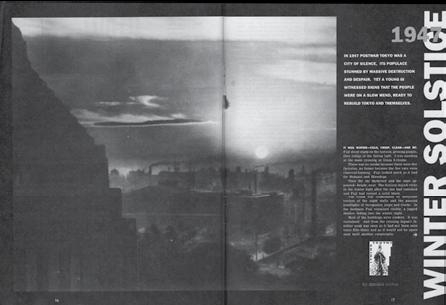
Winter Solstice:1947

The following article by Donald Richie is a reprint of his article that first appeared in the Tokyo Journal in April 1991.

IN 1947 Postwar Tokyo was a city of silence, its populace stunned by massive destruction and despair. Yet a young GI witnessed signs that the people were on a slow mend, ready to rebuild Tokyo and themselves. It was winter – cold, crisp, clear – and Mt. Fuji stood sharp on the horizon, growing purple, then indigo in the fading light. I was standing at the main crossing at Ginza 4-chome.

There was no smoke because there were few factories, no fumes because the few cars were charcoal-burning. Fuji looked much as it had for Hokusai and Hiroshige.

Then the sky darkened and the stars appeared – bright, near. The horizon stayed white in the winter light after the sun had vanished and Fuji had turned a solid black.

The Ginza was illuminated by acetylene torches of the night stalls and the passing headlights of Occupation jeeps and trucks. In the darkness Fuji remained visible, a jagged shadow fading into the winter night.

Most of the buildings were cinders. It was wasteland. And from the crossing Japan’s familiar peak was seen as it had not been seen since Edo times and as it would not be again seen until another catastrophe.
At the crossing there were only two large buildings still standing. One was the Ginza branch of the Mitsukoshi Department Store. But it was gutted, hit by a fire bomb, and even the window frames had been twisted by the heat. Across the street was the white stone Hattori Building with its clock tower. It was much as it had always been, once the clock itself was repaired. With its curved front window, cornices, and pediments, it remained from the pre-war Ginza.

The complete article is available in Issue #271. Click here to order from Amazon

(more…)